 11
11
The first week of a Grand Slam usually gives fans a few scares, a few long nights and a few headlines that disappear by the next round. Novak Djokovic losing in the first round of the US Open is not one of those headlines. It is the kind of result that reaches casual fans, late-night stream watchers and every sports page looking for the moment when a tournament suddenly changes shape.
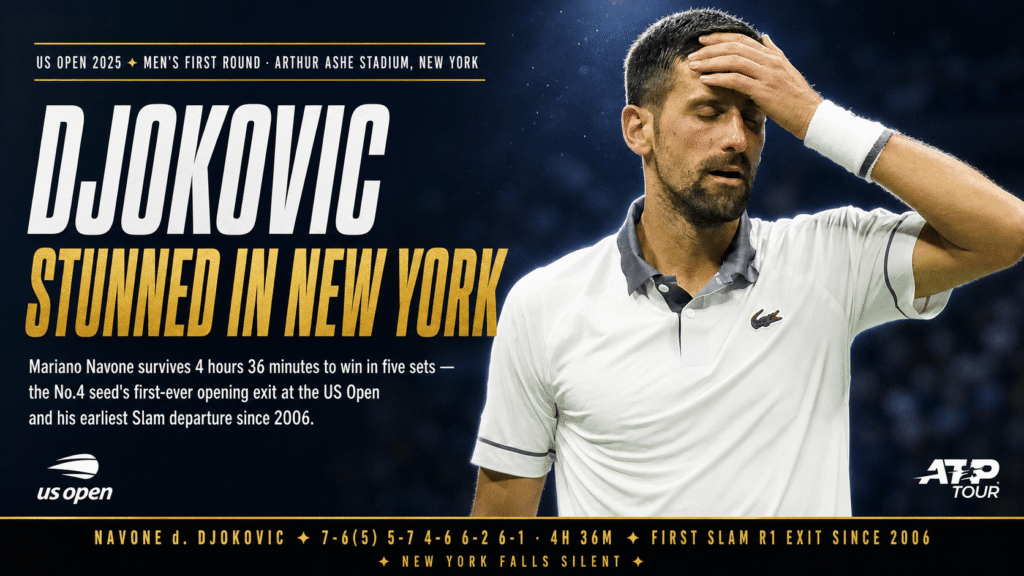
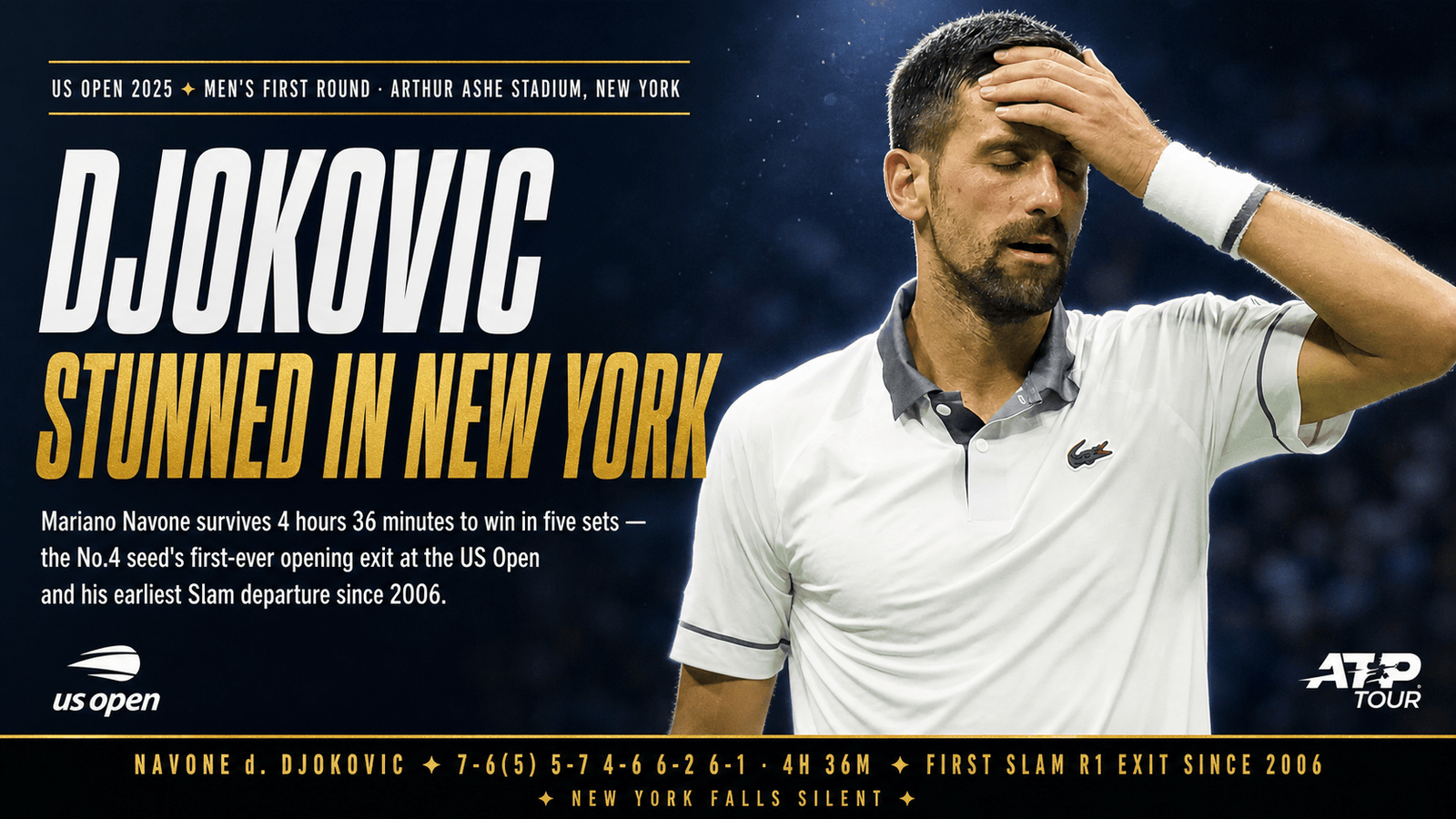
Djokovic was beaten by Argentina’s Mariano Navone at Arthur Ashe Stadium, losing 7-6(5), 5-7, 4-6, 6-2, 6-1 in a match that lasted 4 hours and 36 minutes. The score alone tells you it was a battle. The context tells you why it became one of the biggest tennis stories of the year. Djokovic had never lost in the first round at the US Open. He had not gone out this early at a Grand Slam since the 2006 Australian Open.
For Bangladesh’s tennis audience, which follows the major events closely even without a deep local professional footprint, this is a traffic-worthy global sports story. Djokovic is not just another seeded player. He is one of the names that pulls in readers because his matches always feel connected to records, rivalry and history.
Navone’s win was not a quiet upset on a side court. It came under the lights in New York, against a 24-time Grand Slam champion, and with the match moving from high-level tension into visible physical struggle. Djokovic had moments when he looked ready to pull away. He took the second and third sets after losing the opener, and that usually means danger for the opponent.
But Navone did not accept the usual script. He kept his discipline, continued to stretch rallies and then took control once Djokovic’s body started to fade. The fourth set went 6-2 to the Argentine. The fifth went 6-1. Those numbers are rare against Djokovic in any context, but especially rare in a best-of-five match where he had already moved ahead two sets to one.
That is why the result spread so quickly. It was not only a favourite losing. It was a champion who has defined endurance finding that endurance was not enough.
Djokovic’s condition became impossible to separate from the match. ESPN reported that he vomited at least once, appeared to cramp, took pills brought by a doctor and had his lower back worked on during a medical timeout between the fourth and fifth sets. CNN and AP also reported the heavy physical toll, including the 70 unforced errors that reflected how far from normal his game had become.
After the match, Djokovic spoke about vomiting, cramping and pain. He said his back and shoulder gave up in the end. Those words will worry his supporters because they point to a problem beyond one bad evening.
Tennis has a cruel way of testing older champions. A player can still see the shot, know the pattern and understand the pressure better than anyone else on court. But if the legs are late by half a step, if the serve does not bite, if recovery between sets does not happen quickly enough, the scoreboard can change fast.
Djokovic is 39. That number does not automatically end anything, especially for an athlete who has spent years proving normal sporting rules wrong. But this defeat forces a serious question. Can he still trust his body through seven rounds of Grand Slam tennis?
The natural temptation after a Djokovic defeat is to talk only about Djokovic. Navone deserves more than that. The 25-year-old Argentine walked into the biggest stage of his career and did not panic when the match swung against him. He lost the second set, lost the third and still found a way back.
That tells you something about nerve. Many players have had chances against Djokovic and then played the scoreboard rather than the ball. Navone kept playing the ball. He put depth into exchanges, accepted long rallies and made Djokovic keep moving when movement was becoming harder.
His fifth set was especially impressive because closing against a legend can be mentally awkward. Everyone in the stadium knows the champion’s reputation. Every loose game can feel like the beginning of another famous comeback. Navone gave Djokovic no easy invitation. He finished the match with the calm of someone who knew the opportunity was enormous but not untouchable.
For Argentina, this will be a proud tennis moment. For the wider draw, it is also a warning. Navone is no longer just the player who beat an ailing Djokovic. He is a player who survived a five-set emotional storm at Arthur Ashe Stadium.
The US Open men’s draw has immediately opened up in tone, even if not necessarily in difficulty. Djokovic’s presence changes tournaments because he makes other contenders think about what waits in the later rounds. Remove him early and the energy shifts.
Carlos Alcaraz and Jannik Sinner were already central to the title conversation, and Djokovic’s exit makes their side of the debate even louder. Younger players, dangerous floaters and ambitious seeds will all feel that the path has one less giant in it.
There is also a bigger historical note. ESPN reported that this US Open will be the first Grand Slam since the 2003 French Open without Djokovic, Roger Federer or Rafael Nadal in the second round. That fact lands heavily for a generation of fans who have measured tennis through the Big Three. It is not just about one result. It is about the sport feeling less familiar.
Bangladesh fans who followed the Federer, Nadal and Djokovic years through television, online clips and social media will understand that emotion. The new era has been coming for a while, but nights like this make it feel real.
A Bangladesh sports site should not ignore global stories like this. Cricket and football bring daily volume, but Grand Slam tennis delivers spikes when a superstar is involved. Djokovic’s name carries search demand. The US Open carries global timing. An upset with health drama, five sets and historical weight gives readers several reasons to click and stay.
There is also a broad sports angle that travels well in Bangladesh. Fans here recognise what it means when a great athlete fights against time. It is not only a tennis story. It is a story about ageing, pressure, pride and the body refusing to obey reputation.
That kind of human element can connect with readers who may not know every detail of the ATP ranking list. They know Djokovic. They know he usually survives. This time he did not, and that is enough to make the story feel urgent.
The immediate discussion will be medical and scheduling. Djokovic has played a lighter calendar in recent years to protect his body and target the majors. The problem is that Grand Slams remain physically brutal. There is no hiding from best-of-five tennis, humid nights, long rallies and two-week pressure.
ESPN reported that the defeat will push Djokovic out of the ATP top 10 for the first time since July 2018. That is not just a ranking note. It affects seedings, draws and the psychological picture around him. Opponents may still respect him deeply, but fewer will enter matches believing the old aura alone is unbeatable.
Djokovic has reinvented himself many times. He has recovered from injuries, rebuilt form and answered doubts with trophies. That history means nobody should rush to write him off. But this is not an ordinary dip. It is a physical alarm inside a major defeat.
The tournament now moves with a different soundtrack. Navone must recover from the biggest night of his career and prove he can play again with the same emotional control. Alcaraz, Sinner and the other title contenders will be asked about Djokovic as much as about themselves. Fans will look at the draw and start imagining routes that seemed less realistic a day earlier.
That is the beauty and cruelty of Grand Slam tennis. One night can reshape two weeks. Djokovic arrived in New York with history still possible. He leaves after a defeat that will be replayed for its score, its suffering and its symbolism.
Navone gets the victory of a lifetime. The US Open gets a wide-open storyline. And Djokovic, for once, leaves the first week not as the survivor, but as the question everyone else is trying to answer.