 11
11
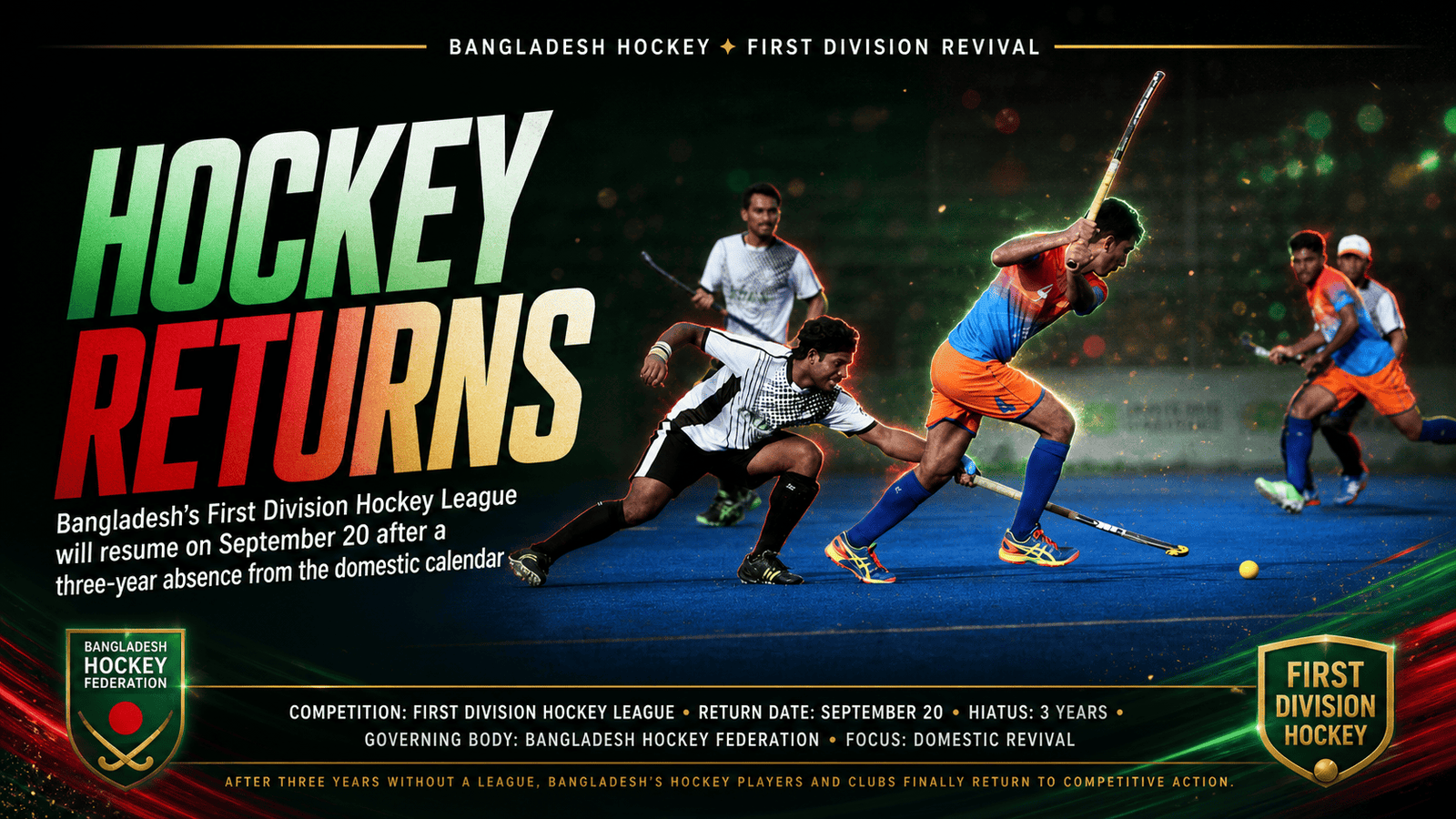
Bangladeshi hockey has waited three years for this. The First Division Hockey League, the country’s top domestic competition, is coming back, with the Bangladesh Hockey Federation deciding to resume it from September 20.
It is the kind of news that matters more than the headline suggests. For three years, the league has been dormant, a casualty of the financial and organisational problems that have so often held Bangladeshi sport back. Clubs struggled, money was short, and the competition that was supposed to be the backbone of the domestic game simply stopped happening. That a league should vanish for three whole years is hard to overstate; a generation of players has effectively been left without its regular stage.
Now the stage is being rebuilt. The federation’s decision to bring the First Division back is the first real sign of movement in a sport that has lived in the shadow of cricket and football for as long as anyone can remember. And while the league may not command the headlines those two sports do, its return carries a weight of its own.
Hockey in Bangladesh has history, and it is worth remembering what that history means. There was a time when the sport produced genuine internationals, when the domestic game was competitive enough to attract overseas players to its clubs, and when a hockey match in Dhaka could draw a crowd that rivaled anything the country’s other sports could muster.
That era faded, gradually and then quickly. The money flowed to cricket, the attention followed, and hockey was left to make do with whatever remained. The three year hiatus in the domestic league only deepened the sense that hockey had been left behind, a sport remembered fondly but no longer taken seriously.
The return of the league is, if nothing else, a refusal to let that happen quietly. It is a statement, however modest, that Bangladeshi hockey still matters, that the clubs and the players who kept the game alive through the lean years deserve a competition worthy of their commitment.
For the players, the three year gap has been brutal. Domestic leagues are where young talent gets its first taste of proper competition, where experienced players earn a living, and where national selectors find their next picks. Three years without that is three years of development stalled.
Think about what that means in practical terms. A promising 18 year old in 2023 would be 21 now, three years of his prime spent without a regular domestic season to sharpen his game. An experienced international would have had his match sharpness blunted by the absence of week in, week out competition. The entire pipeline, from the youngest prospect to the most seasoned campaigner, has been running on empty.
September 20, then, is more than a fixture date. It is the moment a lot of people get back to work, and the moment the sport begins to recover some of the ground it has lost.
The romantic view is that the league’s return solves everything. The reality is more complicated. A league needs clubs that are solvent, fixtures that hold, and players who can actually turn up. The federation will have its hands full simply making sure the competition runs on schedule, let alone raising its standard.
There are deeper questions that no single season can answer. Funding has always been the central problem for Bangladeshi hockey, and it remains so. Infrastructure is another; the country’s hockey facilities have not kept pace with the needs of a modern domestic game. And the national team’s standing, once a source of pride, has declined to the point where qualifying for major tournaments is itself a struggle.
The federation has its critics, and this decision alone will not silence them. But there is a difference between a sport that is struggling and a sport that has given up, and this decision lands firmly on the right side of that line.
There is a broader argument for caring about this, beyond the fate of a single league. Bangladeshi sport, for all the passion that surrounds cricket, has always been at risk of becoming a one sport nation. Football, hockey, athletics, and the host of other disciplines that once formed part of a richer sporting culture have all struggled to compete for attention and resources.
Every time one of those sports shows signs of life, it is worth acknowledging. The return of the hockey league is one such sign. It will not transform Bangladeshi sport overnight, and it will not restore hockey to its former prominence. But it is a step, and a meaningful one, in the right direction.
For the players who have waited three years, for the clubs that have kept going through the uncertainty, and for the fans who have kept faith with a sport that often seems forgotten, September 20 is a date worth marking.
Bangladesh hockey has spent three years on the outside looking in. From September 20, it gets back onto the field.
What happens after that depends on things that are harder to predict than a fixture list. It depends on whether the clubs can sustain themselves financially, whether the standard of competition is high enough to develop players, and whether the federation can build on this first step rather than treating it as an end in itself.
But those are questions for another day. For now, the simple fact is worth celebrating: after three years, the league is back. The hockey sticks will be out again, the turf will see competitive play, and a sport that has been waiting in the wings will finally get its moment back in the middle.
It is not a triumph, not yet. But it is a start, and after three years of nothing, a start is exactly what Bangladeshi hockey needed.