 11
11
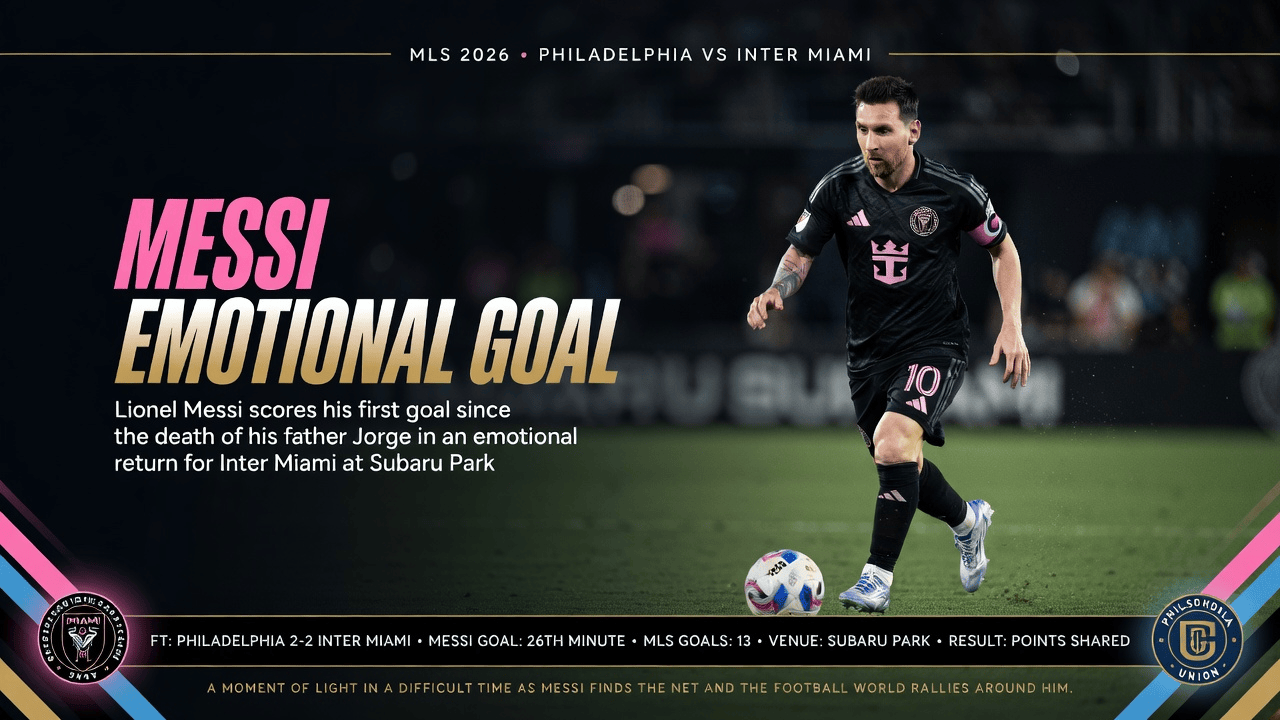
There are goals that mean nothing and goals that mean everything, and on Wednesday night in Philadelphia, Lionel Messi scored the second kind.
It was his first goal since the death of his father, Jorge, two weeks ago, and it came with the kind of weight that no amount of commentary can quite capture. In the 26th minute at Subaru Park, Messi shook off his marker, created half a yard of space, and sent a left footed shot into the net. Then, instead of the usual celebration, he was swallowed up by his teammates, the embrace of eleven men carrying more meaning than any choreographed routine ever could.
For the millions of Bangladeshi fans who have followed Messi’s career with a devotion that borders on the religious, the moment carried its own particular resonance. Argentina’s triumphs have long felt like Bangladesh’s triumphs, and Argentina’s grief, in turn, has a way of feeling like Bangladesh’s grief. When Messi scored on Wednesday, a nation on the other side of the world felt it too.
Jorge Messi died aged 68 on August 8 in Rosario, the city where his son’s extraordinary story began. He was more than a father to Lionel; he was the architect of a career, the man who scraped together the money for growth hormone treatment when the family had little, who sold his way through Argentina’s footballing wilderness to give his boy a chance.
Messi’s own words, shared in a tribute after the death, were raw. He described his father as a father, a friend and a representative, and admitted that he did not know how to continue without him. For a man who has spent his entire adult life in the public eye, the vulnerability was striking.
The goal against Philadelphia, then, was never going to be just a goal. It was Messi stepping back onto the pitch, back into the routine that has defined his life, and finding, in the middle of the grief, the thing he has always done better than anyone else.
The goal gave Inter Miami a 2-1 lead at half time, and for a while it seemed the night might belong to Messi and his teammates. Miami, the defending MLS Cup champions, had arrived in Philadelphia looking to halt a three game losing streak, and Messi’s strike suggested they might just do it.
But football rarely co-operates with sentiment, and Philadelphia, chasing a fifth consecutive victory, found a late equaliser to force a 2-2 draw. The match also saw red cards, with both sides finishing with ten men, and the result left Miami’s difficult run extended by another game.
The draw was a footnote, in the end. The night belonged to the moment in the 26th minute, when Messi scored and his teammates held him and the football world, for a few seconds, stood still.
The goal was Messi’s 13th of the MLS season, leaving him one behind Dallas striker Petar Musa in the race for the Golden Boot, a title he won last season. It was also his first since returning from the World Cup break, a gap that had seemed to stretch far longer than it actually was.
Those numbers matter to the statisticians and the fantasy football players, but they miss the point entirely. What mattered on Wednesday was not the tally, but the act itself, the proof that Messi, even in the grip of grief, remains capable of producing the moments that have defined his career.
He captained Argentina to this year’s World Cup final, where they lost to Spain, and he has spent the weeks since navigating a loss far more profound than any on the pitch. The goal in Philadelphia was not a return to normal. Nothing will be normal for a while. But it was a step back toward the light, and it was unmistakably, defiantly Messi.
It is worth dwelling, briefly, on why this resonates so deeply in Bangladesh, because the connection is real and it is specific.
Bangladesh’s love affair with Argentine football stretches back decades, to Diego Maradona’s 1986 World Cup triumph and beyond. It is a love that has been passed down through generations, that paints the streets blue and white on match days, that treats Argentina’s victories as collective national celebrations. Messi inherited that devotion and, if anything, deepened it.
When Jorge Messi died, the grief in Bangladesh was genuine. And when Messi scored on Wednesday, the joy was genuine too. It is a strange thing, this bond between a South Asian nation and a South American football team, but it is one of the most enduring and affecting stories in the global game.
So the goal in Philadelphia mattered twice over. Once for Messi, who found a moment of light in a dark time. And once for the millions of fans in Bangladesh and beyond, who watched their hero do what he has always done, and felt, however briefly, that everything might be alright.
Messi will continue, as he always has. The grief will not disappear, but it will settle, and the football will go on, and there will be more goals, more moments, more nights like Wednesday. The season has months left to run, and Miami, for all their recent struggles, remain one of the most dangerous sides in the league when Messi is on song.
For now, the image that lingers is the one from the 26th minute: Messi shaking off his marker, finding the space, scoring, and being held by his teammates. A goal, an embrace, and a father watching from somewhere beyond the floodlights.
It was not just a goal. It was a beginning.