 11
11
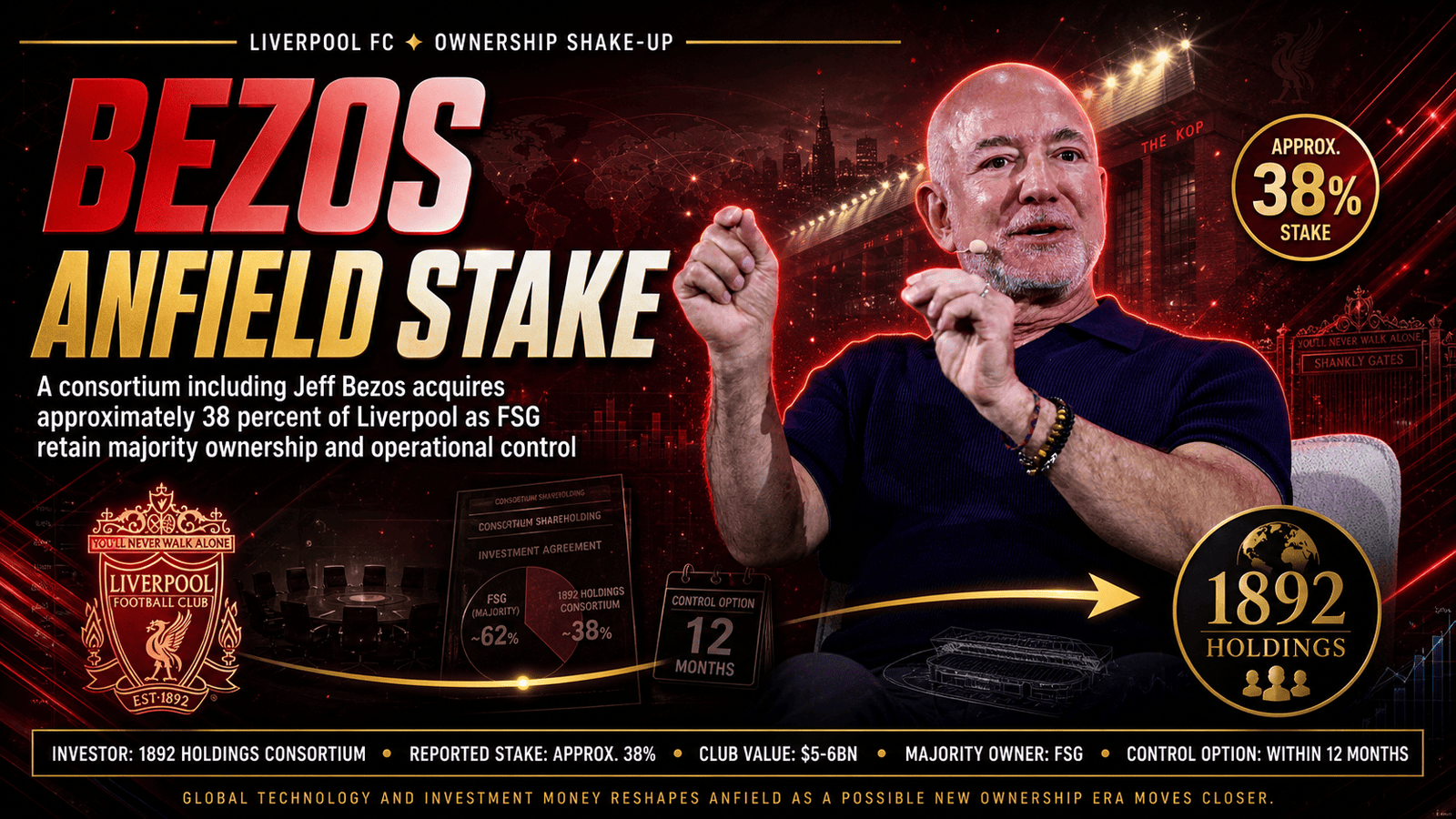
A consortium including Amazon founder Jeff Bezos has bought close to 40 percent of Liverpool Football Club, a stake far larger than the roughly 30 percent that was initially reported. The revelation, first disclosed by The Athletic, casts the investment in a new light and raises the prospect that one of the world’s wealthiest men could eventually take control of one of football’s most storied clubs.
When Fenway Sports Group (FSG), Liverpool’s owners, announced on Friday that they had agreed a deal with 1892 Holdings, early indications suggested the consortium had purchased a stake of around 30 percent to one third of the club. The Athletic has now reported that the true figure is much closer to 40 percent, at approximately 38 percent.
That is a substantially larger shareholding than first thought, and it places the consortium, led by British-Indian businessman Amit Bhatia, in a position of significant influence at Anfield. The deal values Liverpool at between five and six billion dollars.
Perhaps most significantly, the agreement includes an option for the consortium to purchase a controlling stake in the club within the next 12 months. While both sides have stressed that this is not a formal commitment and that there is no guaranteed plan for an outright takeover, the mechanism is now in place for that possibility.
The consortium is led by Amit Bhatia, the former Queens Park Rangers co-owner, who will take up the position of vice-chairman at Liverpool. Bhatia is the son-in-law of Indian billionaire Lakshmi Mittal, and his involvement has given the deal a significant South Asian dimension.
Alongside Bezos, the consortium includes the family office of Facebook co-founder Eduardo Saverin and his wife Elaine, as well as the Mittal Family Trusts. Bezos’ involvement comes through K5 Sports, and while he will not have a seat on the board, his presence is the headline that has captured global attention.
This is Bezos’ first foray into sports ownership, having previously been linked with NFL franchises the Seattle Seahawks and the Washington Commanders. The Amazon founder is the fourth richest person in the world, with an estimated net worth of $256 billion.
Despite the scale of the investment, FSG will continue to be majority shareholders and retain operational control of the club. The Boston-based company, which bought Liverpool for £300 million in 2010, has framed the deal as a strategic investment rather than a sale.
“The strategic investment supports Liverpool FC’s long term growth ambitions by bringing together experts from across global business, technology and investment,” FSG’s statement read.
Bryan Baum from K5 Sports and Elaine Saverin will join Bhatia on the Liverpool board, bringing with them expertise from the worlds of technology and investment.
The investment arrives at a pivotal moment for Liverpool. The club is looking to bounce back from a disappointing fifth place finish in the Premier League last season, a failure that cost Arne Slot his job just 12 months after he had masterminded a title triumph.
New manager Andoni Iraola is overseeing a rebuild, and the club has already spent around £94 million on signing Jeremy Jacquet and Victor Munoz this summer. The injection of capital and expertise from the new investors could provide a boost as Liverpool look to strengthen further before the transfer window closes.
The deal is understood not to have been driven by financial necessity on FSG’s part, but the additional resources and the calibre of the investors involved can only be a positive as the club seeks to return to the summit of English football.
The Liverpool investment is the latest example of American capital, and increasingly technology money, flowing into English football. The involvement of Bezos, one of the most recognisable figures in global business, is a statement about the enduring appeal of Premier League clubs as investment vehicles.
For Liverpool supporters, the news will be greeted with a mixture of excitement and caution. The prospect of Bezos’ wealth being deployed in the service of the club is enticing, but the memory of other high profile takeovers, not all of which have worked out, will temper enthusiasm.
For now, FSG remain in charge, and the day to day running of the club is unchanged. But the presence of Bezos and his fellow investors in the background, with an option to take control, means the landscape at Anfield has shifted. A new era, of one kind or another, may be approaching.
The immediate focus for Liverpool is the start of the new Premier League season, with Iraola’s side looking to begin their campaign strongly and put the disappointment of last season behind them.
The new investment is unlikely to lead to dramatic changes overnight, but the resources and expertise now available to the club could accelerate its plans, both on and off the pitch.
Whether Bezos ultimately decides to pursue a controlling stake remains to be seen. But the mechanism is in place, and the world’s fourth richest man now holds a significant interest in one of football’s greatest institutions. The implications of that, for Liverpool and for the wider game, will unfold over the months and years ahead.