 11
11
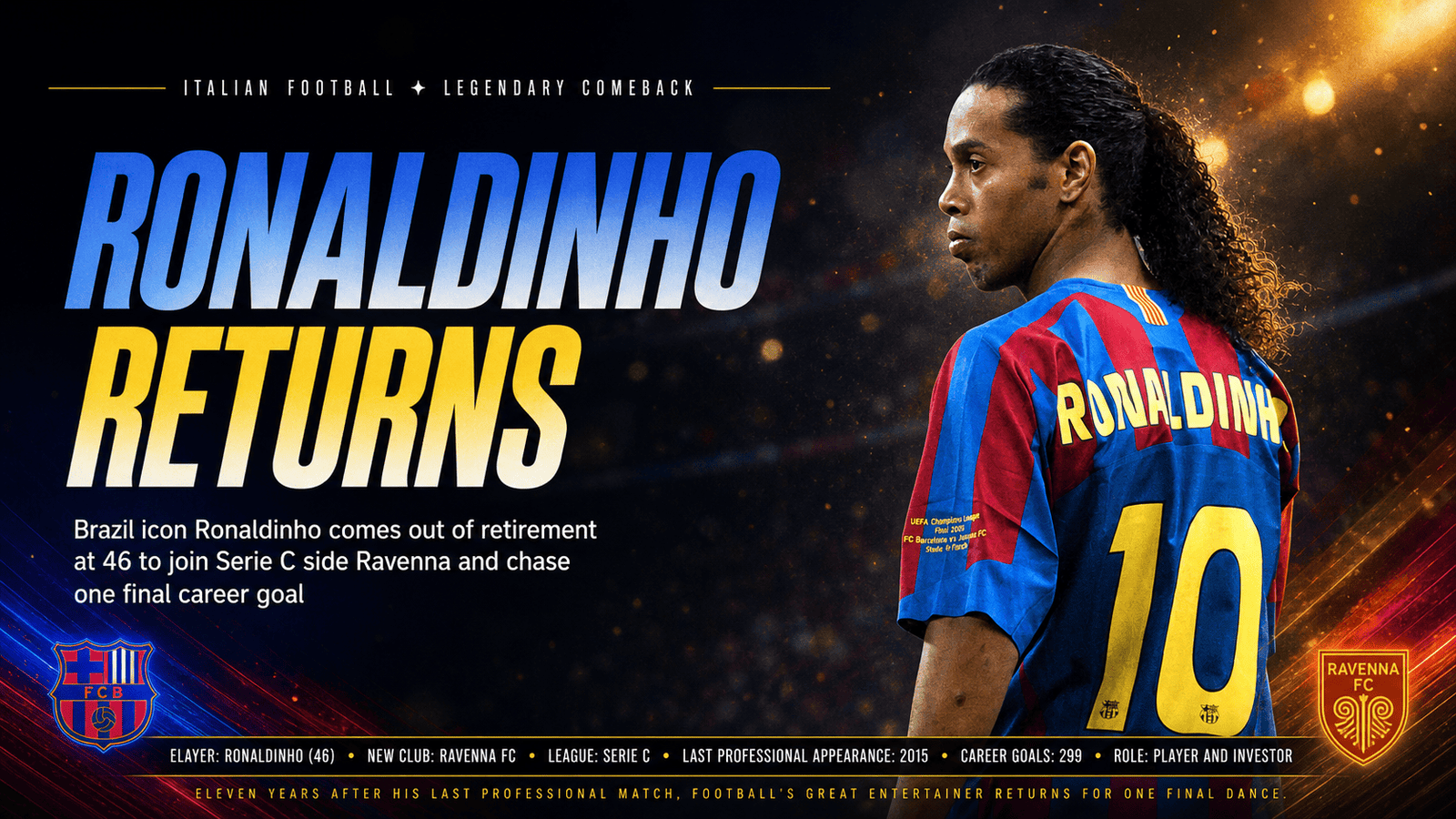
Some retirements are final. Others are merely pauses. Ronaldinho, the most joyful footballer of his generation, has decided his was the second kind.
At 46 years old, eleven years after his last professional appearance, the Brazilian has come out of retirement to sign for Ravenna, a Serie C side in northern Italy. The announcement, made in the most Ronaldinho way imaginable, came at a beach festival on the Adriatic coast, where six thousand fans gathered to welcome back a man who has never quite been able to leave the game alone.
“Football has always been joy for me,” Ronaldinho said, and there is no reason to doubt him. This is not a comeback driven by money, or by a need to prove anything. It is the return of a man who simply cannot stay away from the thing he loves most.
The mechanics of the arrangement are as unusual as everything else about it. Ronaldinho has not merely signed as a player; he has become part of the ownership group at Ravenna, a club owned by Ignazio Cipriani, the grandson of the founder of Harry’s Bar in Venice.
Cipriani has been adamant that this is not a marketing stunt, insisting that Ronaldinho will take the pitch for at least one official match. The aim, he has said, is for the Brazilian to score “the final goal of his career” in a Ravenna shirt.
It is a strange, romantic arrangement, and it is hard not to be charmed by it. A third tier Italian club, an ageing genius, and a plan that seems to exist somewhere between a business venture and a dream. In a sport increasingly defined by cold calculation, there is something almost innocent about it.
Ronaldinho’s own motivation is simple, and it is typically him. He wants to score one more goal. Not for the record books, not for the money, but because the thought of it makes him happy.
The Brazilian has 299 career goals to his name, depending on who is counting, and the prospect of reaching a round 300 has clearly caught his imagination. “If that happens, it will be even more beautiful,” he said when asked about the milestone.
There is no date set for his debut, and it remains unclear how many matches he will actually play. He will not feature in Ravenna’s season opener, and his fitness, at 46, is an open question. But the intention is there, and the romance of it is undeniable.
To understand why this comeback matters, you have to remember what Ronaldinho was.
He was, for a period in the mid 2000s, the most magical footballer on the planet. At Barcelona, he played with a smile and a swagger that made the game seem like a form of play rather than a profession. He won the Ballon d’Or in 2005, the Champions League in 2006, and the World Cup with Brazil in 2002. His skill was not just effective; it was joyful, and it made millions of people fall in love with football.
He played for Paris Saint-Germain, Barcelona, AC Milan, Flamengo, Atletico Mineiro and Queretaro, collecting trophies and adoration wherever he went. And then, in 2015, at Fluminense, he quietly stopped.
The retirement, when it came officially in 2018, felt less like an ending than a formality. Ronaldinho had already become a figure of the past, a legend remembered fondly but no longer feared. And yet here he is, eleven years later, lacing up his boots for one last dance.
What has always set Ronaldinho apart is not the trophies or the records, but the joy. He played football the way children do, with a delight that was contagious, and that joy is the reason this comeback feels like something worth celebrating.
There is a cynicism to modern football that Ronaldinho never quite belonged to. He was not a machine, not a product, not a brand first and a player second. He was simply a man who loved the game, and who made everyone watching love it a little more too.
That is why six thousand people gathered on a beach in Ravenna to welcome him back. It is why, even now, at 46, his return generates headlines around the world. Ronaldinho represents something that football, in its relentless professionalism, has largely lost: the simple, uncomplicated happiness of playing.
It is worth noting, in passing, how Ronaldinho’s return resonates in a place like Bangladesh, where the love of football runs deep and the names of the great Brazilian stars are spoken with a reverence that borders on the religious.
Bangladesh’s passion for Brazilian football is well documented, and Ronaldinho, as one of the most beloved figures of that golden era, occupies a special place in the hearts of Bangladeshi fans. His comeback, however improbable, is the kind of story that reminds people why they fell in love with the game in the first place.
There is something universal about it, too. A man of 46, deciding he wants to play one more match, to score one more goal, simply because he can. It is a story that transcends borders and cultures, and it is one that resonates as strongly in Dhaka as it does in Ravenna.
Ronaldinho’s debut date remains unknown, and it is entirely possible that the whole thing amounts to little more than a cameo, a few minutes of magic from a man who was once the best in the world. But that, in a sense, is exactly the point.
The joy of this comeback is not in what Ronaldinho might still achieve, but in what he represents. It is a reminder that football, for all its money and its pressure, is still, at its heart, a game. And Ronaldinho, more than almost anyone, has never forgotten that.
Let the magic begin, he said. And for the fans who grew up watching him, and the new generation who will see him for the first time, there is every reason to believe it will.