
 11
11
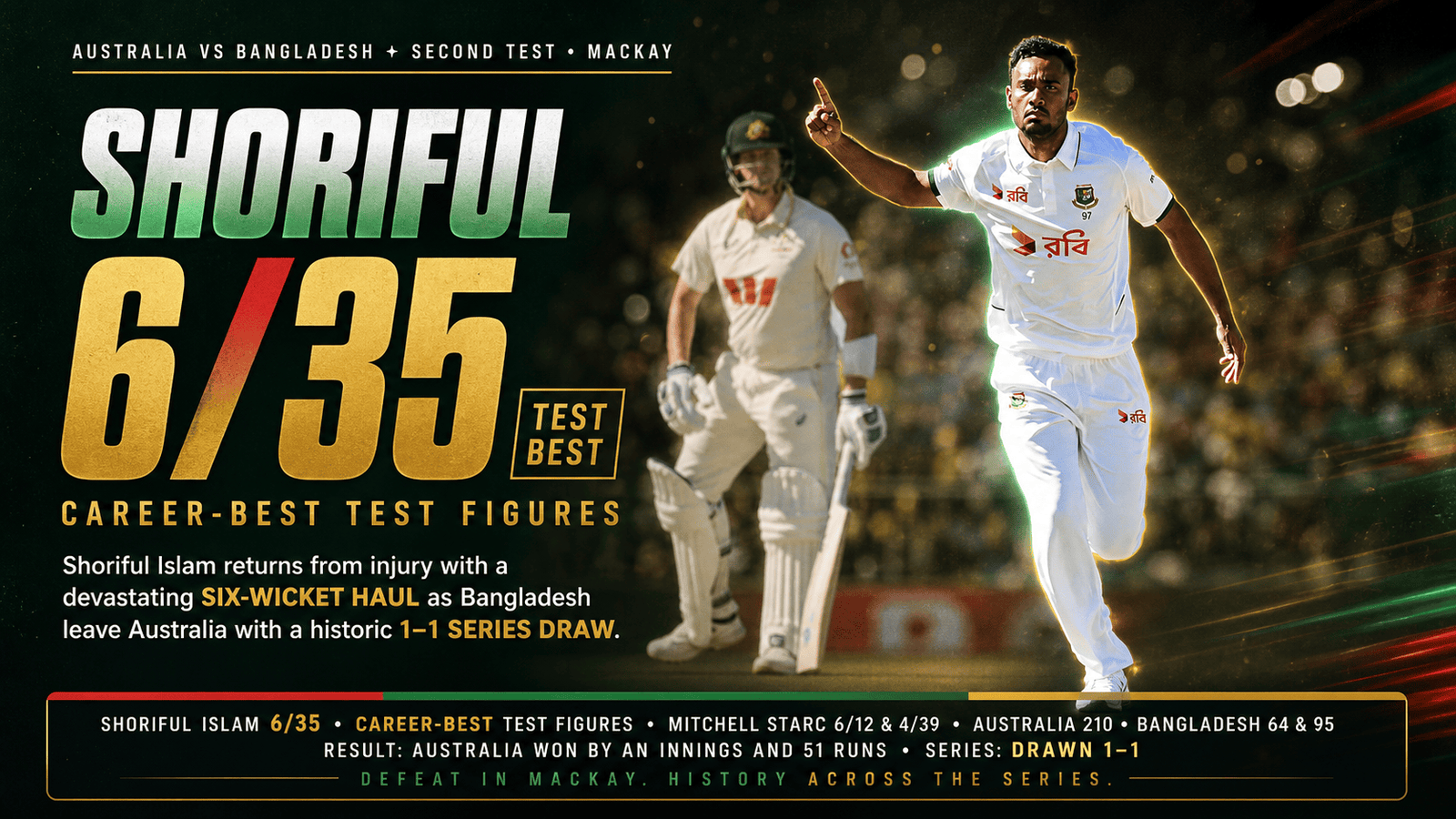
There are days when a Test match forgets that it is supposed to last five days. Mackay produced one of them, and Bangladesh spent most of it discovering that a game can be lost and half won again inside a single afternoon.
Eighteen wickets fell on the opening day of the second Test. Two hundred and twenty-nine runs were scored between them. And by the close of play, a Bangladesh side that had been bowled out for 64 before lunch had somehow bowled their way back into a contest that looked finished by mid-morning.
The man responsible was the one who had not played a single Test all series.
Mitchell Starc dismissed Shadman Islam with the very first delivery of the match. What followed was not really a collapse. It was a demolition.
Pat Cummins had won the toss and chosen to bowl, telling the broadcasters that the wicket looked pretty good but that if there was any moisture in it, this would be the morning it showed. He was proved right almost immediately, and rather more emphatically than he can have expected.
Starc reached five wickets in twenty-two deliveries. That is the sixth-fastest five-wicket haul in the history of Test cricket measured by balls bowled, and it is worth remembering that the fastest belongs to Starc as well, from fifteen balls against the West Indies last year. Bangladesh were 35 for 6 in a first session that lasted twenty-three overs and produced almost nothing else.
Four of the top six made ducks. The innings closed on 64 in exactly thirty-four overs, the fourth-lowest total in Bangladesh’s Test history, with Starc finishing on 6 for 12 from ten overs of which six were maidens.
The only resistance came from a place nobody would have chosen. Shoriful Islam, batting at number eleven, top-scored with 14 from nineteen balls, adding 25 with Taijul Islam for the last wicket. It was the highest partnership of the innings by some distance, and it was only the thirteenth time in the history of Test cricket that a number eleven has top-scored for his side, and the first time it has happened against Australia.
Starc eventually found the edge of Shoriful’s bat to finish the job. At that point the story of the day appeared to be written.
Australia raced to 50 inside ten overs. The lead was going to be enormous, the match was going to be over, and the only question was how quickly.
Then Shoriful, who had recovered from the side strain that kept him out of the Darwin Test, began his answer.
Travis Head chopped on. Marnus Labuschagne was bowled for four. Taskin Ahmed removed Matt Renshaw, and suddenly Australia were three down and the innings had a different feel to it. Bangladesh went to tea with the home side on 50 for 3, still trailing.
After the interval, Shoriful produced something closer to an event than a spell of bowling. Steve Smith went for 42. Then, in the space of a single over, Beau Webster was given out lbw for a golden duck after playing down the wrong line, and Pat Cummins fell two balls later, fending a short delivery onto his glove for Litton Das to take.
Two overs after that came the delivery of the day. Left-arm over the wicket to a left-hander, wide on the crease, plenty of angle coming in. Starc defended down the expected line, was beaten on the outside edge, and lost his off stump to a ball that straightened sharply off the pitch.
Six wickets for 35 from eleven overs. His best figures in Test cricket by a comfortable margin, and six of the eight Australian wickets that fell all day. Five of them came after tea.
Two bowlers taking six wickets each on the opening day of the same Test match has now happened four times in the entire history of the format.
The previous three were Sydney Barnes and Monty Noble at Melbourne in 1902, Aubrey Faulkner and Colin Blythe at Leeds in 1907, and Frank Worrell and Bill Johnston at Adelaide in 1951. Starc and Shoriful have joined a list that had not been added to in seventy-five years.
The eighteen wickets in a day were the third-highest tally on the opening day of a Test played in Australia since 1975. A wicket also fell from the very first ball of the first Test ever staged at Mackay, which has previously happened only at Jalandhar, Jaipur and Pallekele.
For a ground hosting its first Test match, it was quite an introduction.
The honest reading of all this is that Shoriful’s spell bought Bangladesh a day rather than a match.
Australia closed the opening day 101 runs ahead with two wickets still standing, Cameron Green unbeaten on 32 and Alex Carey on 20. Green went on to make 67 as Australia posted 210, and Starc returned in the second innings with 4 for 39 to finish with ten wickets in the match. Bangladesh were dismissed for 95, and the Test was over inside two days by an innings and 51 runs.
That is a heavy defeat by any measure, and there is no particular use in pretending otherwise.
But the series finished 1-1. Bangladesh had never won a Test match in Australia before this month, and they had not played a series there in twenty-three years. A shared series against the best Test side in the world, on their own soil, is not a result that needs qualifying.
Shoriful’s six-for is the kind of performance that changes how a bowler is selected rather than how a particular match finishes.
He missed Darwin through injury and watched from the sidelines as Hasan Mahmud took six wickets in a famous win. He came back in Mackay and matched it. Bangladesh’s pace attack, for years the department that quietly let them down whenever they left the subcontinent, now contains two seamers who have each run through an Australian top order inside a fortnight.
That is not a small thing, and it becomes considerably less small in November. Bangladesh travel to South Africa for two Tests, in Johannesburg and Centurion, carrying a new ICC ranking of sixth in the world, the highest position they have ever held. Those are surfaces that reward pace, bounce and the kind of angle Shoriful was getting in Mackay.
The Tigers went to Australia ranked ninth and hoping to compete. They came home ranked sixth with a Test win and a six-wicket haul that put two names in a record book alongside Sydney Barnes. Whatever happens in Johannesburg, the month of August 2026 is going to take some beating.