 11
11
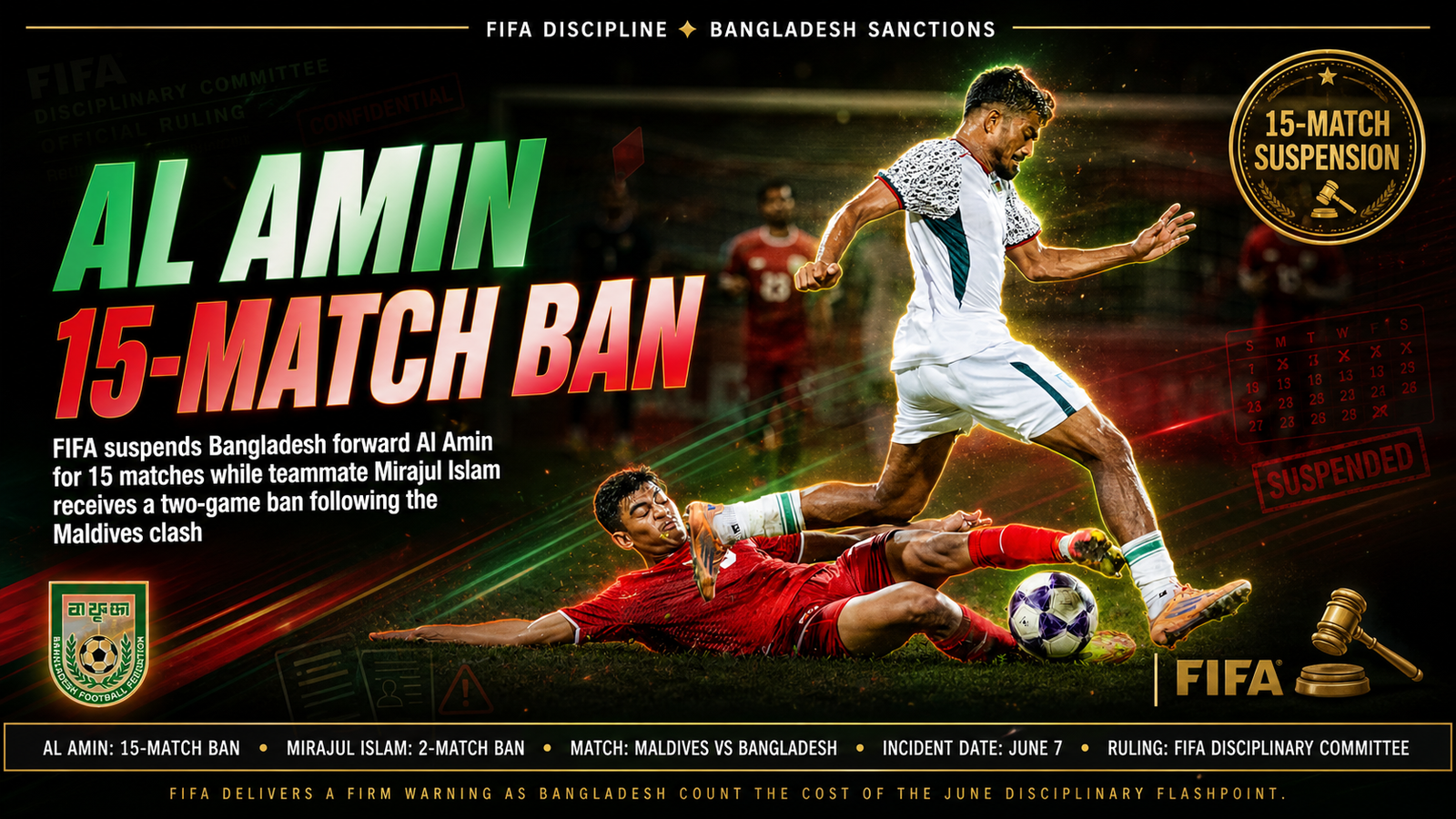
Bangladesh forward Al Amin has been handed a severe 15 match suspension by FIFA’s Disciplinary Committee, while teammate Mirajul Islam has received a two match ban, over the ugly scenes that marred the Maldives versus Bangladesh match in the Diamond Jubilee International Football Tournament on June 7. The punishments, announced on Tuesday, mark the heaviest disciplinary action against a Bangladeshi international in recent memory and will sideline one of the country’s most promising attackers for a significant stretch.
The controversy dates back to June, when Bangladesh’s match against Maldives descended into chaos. Al Amin, who had already represented the senior national team, was shown a second yellow card and then a red card after displaying his frustration. What followed was far more serious, with the forward repeatedly pushing the referee to protest the decision, prompting his teammates to physically restrain him.
Mirajul Islam, Bangladesh’s goalscorer on the night, was also dismissed from the bench for abusing the match official. Both players received straight red cards, and the fallout has now reached its conclusion with FIFA’s disciplinary ruling.
The incidents were all the more costly given the context. Had Bangladesh won the match, they would have progressed to the final of the tournament. Instead, the match ended in a draw, and Afghanistan secured the spot in the showpiece instead.
FIFA’s Disciplinary Committee has now confirmed the sanctions, handing Al Amin a 15 match suspension for his conduct, a punishment that reflects the severity of his actions towards the referee. Mirajul Islam received a two match ban for abusing the official.
Under FIFA’s disciplinary code, players who assault or seriously confront match officials can face suspensions of at least four to six matches. Al Amin’s 15 match ban sits well above that threshold, a clear signal that FIFA viewed his conduct, repeatedly pushing the referee, as a serious breach of the game’s rules.
The length of the suspension means Al Amin will miss a substantial portion of the upcoming season, a significant blow for both the player and his club side.
Al Amin, who plays for Dhaka Abahani, has long been regarded as one of Bangladesh’s most promising young forwards. His rise through the ranks has been watched closely, and he had begun to establish himself at senior international level.
This suspension, however, threatens to stall that progress. A 15 match ban represents a lengthy absence from competitive football, and the disciplinary black mark against his name will linger. For a player still in the early stages of his international career, the timing could hardly be worse.
The incident also serves as a cautionary tale about the consequences of losing control on the pitch. What began as frustration over refereeing decisions has now resulted in one of the heaviest bans ever handed to a Bangladeshi footballer.
The June incident was not an isolated flashpoint, but rather a reminder of the challenges that have periodically dogged Bangladeshi football. Disciplinary issues, both on and off the pitch, have at times undermined the progress of the national team and the domestic game.
The Bangladesh Football Federation (BFF) will be keen to avoid any repeat, and the FIFA ruling sends an unambiguous message to players about the standards expected at international level. The governing body has made clear that conduct towards match officials will be dealt with severely.
For the national team, the absence of Al Amin and Mirajul Islam will be felt. Both players have been part of the setup, and their suspensions come at a time when Bangladesh are trying to build momentum and improve their standing in the region.
Al Amin will now begin serving his 15 match ban, with a lengthy period on the sidelines ahead of him. The focus for the player will be on rehabilitation, both in terms of match fitness and, more importantly, in terms of the disciplinary lessons that must be learned.
Mirajul Islam’s two match ban is far lighter, and the forward will be available again after a short absence.
For the BFF and Bangladeshi football more broadly, the ruling is a reminder of the importance of discipline. The talent within the national setup is undeniable, but it must be paired with the composure and professionalism that international football demands.
The hope now is that this episode serves as a turning point, a lesson learned the hard way, and that both players return stronger and wiser from their enforced absences.